Dudhwa National Park, Uttar Pradesh
Area of the Park: 680 sq kilometers
Year of Establishment: 1st February 1977
Best Season to Visit: November to May
Please provide us your contact number and convenient time, our expert will call back to you.
Dudhwa National park is located in Lakhimpur Kheri District of Uttar Pradesh. This area falls under sub Himalayan Region known as Tarai Belt. Tarai Region is one of the most endangered ecosystems around the globe. The beautiful region of the park incorporates lush Sal forests, swamp and grasslands. Bequeathed with amazing wilderness, Dudhwa National Park is among the most vivacious protected areas in the country.
The tuneful twittering of the birds in Dudhwa National Park greets the new dawn. The little sun rays, which arrive at the ground, interlace a miraculous demonstration of illumination and shade on the canvas of verdant leaves. Without a doubt, this enticing region has everything that attracts a wildlife lover and nature admirer. Moreover, it one of the thickest national parks in India, in respect of woods.
One of the major Indian conservationists, Billy Arjan Singh, put a great effort to establish this park as a sanctuary of Swamp Deer. Later, this imposing national park became a habitat for tigers and leopards as well. Interestingly, Dudhwa is the only place on the planet that is inhabited by 5 deer species. The grasslands of this national park abode a remarkable population of one-horned rhinos. In 1984, one-horned rhinos Nepal and Assam were introduced in Dudhwa. Moreover, critically rare wildlife species like Hispid Hare and Bengal Florican has been rediscovered here in Dudhwa National Park.
Excursions near Dudhwa National Park
For all the tourists visiting Dudhwa National park, there are some excursion places nearby adding cheery on the cake. One such place is the unique frog temple of Oyal. This temple was constructed by Maharajas of Oyal in Lakhimpur-Kheri. This shrine is in shape of a frog and is dedicated to Lord Shiva. It is situated at a distance of 10 kilometers from Hargaon, which comes on the route to Dudhwa.
Surat Bhawan Palace, built in Indo-Saracen style, is also a great place to visit while on the tour to Dudhwa. This site was built by the emperors of Singhai state. This imposing palace is in nine-acre retreat filled with verdant lawns, swimming pool, fountains, and mesmerizing architecture.
Wildlife in Dudhwa National Park
Fauna wealth of Dudhwa National Park is grippingly flourishing and exotic. There are in total 47 mammal species, 35 reptile, 10 amphibian, 37 butterfly and 449 bird species found here.
Fauna of Dudhwa National Park: The rare mammal species making Dudhwa as a habitat are tigers, leopard tigers, leopard cats, hispid hare, giant flying squirrel, pangolin, ratel, swamp deer, fishing cat, and one horned rhinos. The significant reptile wealth of park includes crocodile, gangetic soft-shelled turtles, gavial, Indian tent turtle, and terrapin batagur basak, shell terrapin, eastern hill terrapin, and spotted terrapin. Moreover, the avifauna species filling the ambiance of park with pleasant chirping are black crested braza, great Indian hornbill, Bengal florican, laggar falcon, Indian pied hornbill, peafowl, osprey, shaheen falcon and red headed Merlin.
Flora of Dudhwa National Park: The major types of foliage that covers the Dudhwa National Park are Swamp and Riparian Forest, Tropical Moist Deciduous Forests, Dry Deciduous Forests and Tropical Evergreen Forests. Te significant tree species that make this park astonishingly verdant are Shorea Robusta, Dalbergia Sissoo, Terminalis Tomentosa, Eugenia Jambolana, Adina Cordifolia, Bombax Malabaricum and Terminalia Belerica.
Dudhwa National Park Travel Information
Dudhwa National Park is easily accessible from Lucknow. A well-connected railways and roadways connect the park with Lucknow. For the tourist coming here through air can take off at Lucknow and then can proceed through roadways.
By Air: Lucknow Airport (234.1 kms) is the nearest airport from the park
By Rail: Dudhwa Railway Station (4 kms) is the nearest railhead.
By Road: There are lots of buses from Uttar Pradesh State Road Transport Corporation that run between Lucknow and Dudhwa National Park.
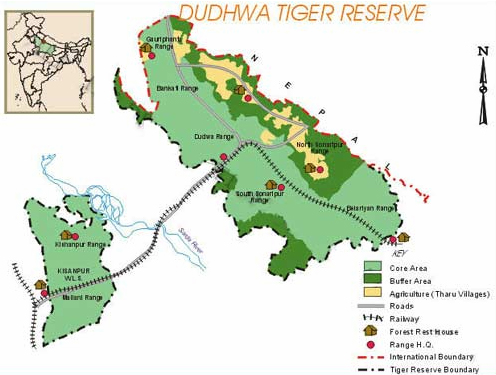
Dudhwa National Park Map