


Tiger Photography Tour
Delhi - Jaipur - Agra - Jaipur - Ranthambore National Park - Bharatpur - Agra - Umaria - Bandhavgarh National Park - Delhi
Day 01 : Arrive Delhi
On arrival at the airport our representative will meet you at the airport arrival lounge, and will provide you transfer to the hotel. Overnight stay at hotel.
Day 02 : Delhi
Morning after breakfast full day city sightseeing tour of Old Delhi & New Delhi. In the evening return to the hotel. Overnight stay at hotel.
Old Delhi - the 350-year-old walled city was built by Emperor Shah Jehan in 1648 as his capital. Opposite the fort are the black and white onion dome and minarets of the Jama Masjid, the most elegant mosque in India. Raj Ghat is worth a visit where Mahatma Gandhi was cremated in 1948.
New Delhi - the new capital designed by Sir Edward Lutyens. An interesting drive in the one passing through the impressive Rajpath from the World War I memorial arch, the India Gate towards the Presidential Palace. Visit Humayun's Tomb built in 1565 AD, Safdarjung's Tomb, the Qutub Minar, 72 meters high and the most curious antique, the uncorroded Iron Pillar, which dates back to the 4th century AD.
Day 03 : Delhi - Jaipur (270 km)
Morning after breakfast drive to Jaipur, On arrival check in at the hotel. In the evening city sightseeing tour of the pink city visit, including the massif City Palace, Jantar Mantar (Natural Observatory), Hawa Mahal (The Palace of winds). Overnight at hotel.
Day 04 : Jaipur - Ranthambore (180 km)
Morning an excursion tour to Amber fort. At a short distance of 11 kms . from Jaipur.
Amber Fort complex stands amidst wooded hills overlooking the Delhi-Jaipur highway, with its forbidding ramparts reflected in the still waters of the Maota Lake below. One of the finest examples of Rajput architecture, it was the ancient capital of the Kachhawah rulers. The original palace was built by Raja Man Singh and additions were made later by Sawai Jai Singh.
Within the palace are the Diwan-e-Aam or the "Hall of Public Audience", the Diwan-e-Khas or the "Hall of Private Audience" and the Sukh Niws where a cool breeze blows across channels of water for the purpose of air-conditioning. Here are the private chambers of the queens with windows having latticed screens so that the ladies could watch the proceedings of the royal court in privacy. There is also the Jai Mandir or the "Temple of Victory", with its famed Sheesh Mahal, the scintillating "Hall of Mirrors".
Continue drive to Ranthmabore, On arrival check in at wildlife resort, After having lunch we will take you for the safari into the national park, Dinner and O/N stay at Wildlife Resort.
Day 05 : Ranthambore National Park
Morning and evening Jeep Safari into the national park. Overnight stay at wildlife resort.
Ranthambore national Park : It spread over 400 sq kms of dry deciduous forest. A perfect natural habitat for tigers, and is set in the Aravalli and Vindhya hills, dotted with pavilions and dominated by a hilltop fort. Ranthambore was one of the hunting preserves of the former rulers of Jaipur and because of this the Maharajas ensured the environment was preserved and the forest and their inhabitants well protected. It has a good population of tiger and their prey species, and has been declared a "Project Tiger" reserve. Wildlife includes blue bull, black buck, spotted deer or cheetal, wild boar, a large variety of bird species and, if very lucky, the rarely seen leopard. "
Day 06 : Ranthambore National Park
Morning and afternoon game drive in to the National Park. Overnight stay at resort.
Day 07 : Ranthambore - Bharatpur (200 km)
Morning transfer to the station time to catch train for Bharatpur. On arrival met at the station. Evening visit the bird sanctuary. Overnight stay at hotel.
More than 300 species of birds are found in this small wildlife park of 29-sq-kms of which 11-sq-kms are marshes and the rest scrubland and grassland. Keoladeo, the name derives from an ancient Hindu temple, devoted to Lord Shiva, which stands at the centre of the park. 'Ghana' means dense, referring to the thick forest, which used to cover the area.
Day 08 : Bharatpur
Morning drive to Bharatpur Bird sanctuary, on arrival check in at the hotel. In the evening visit the sancturay for bird watching. Overnight at hotel.
Day 09 : Bharatpur / Fatehpur Sikri / Agra
Morning after breakfast drive to Agra via Fatehpur Sikri. After visiting Fatehpur Sikri continue drive to Agra. On arrival check in at the hotel. Rest of the day free at leisure. Overnight at hotel.
Day 10 : Agra / Umaria
Visit the world famous Taj Mahal at dawn. Also visit Red Fort. In the afternoon transfer to the railway station to board the train for Umaria. Overnight on board.
Day 11 : Umaria - Bandhavgarh (35 km)
Morning arrive Umaria on arrival meet at the station with our representative and transfer to the Forest resort. Morning free at leisure, in the afternoon we will take you for the safari into the national park. Overnight stay at Forest resort.
Bandhavgarh lies in the heart of Madhya Pradesh- traditional tiger country. This is where Rudyard Kipling found inspiration for his famous Jungle Book (remember Mowgli?), and this is where the tiger still roams- although now protected by dozens of laws, some effective, some not.
Once the hunting preserve of the Maharajas of Rewa, where an alarming number of tigers were hunted down in pre-independence India, Bandhavgarh was mercifully declared a National Park in 1968. Today, the Bandhavgarh National Park is a compact reserve (448 sq. km) of sal trees, bamboo thickets and grasslands, teeming with birds and animals and the highest population of tigers anywhere in India. The park is now home to 22 species of wildlife, including the regal 'gaur', umpteen varieties of deer, and carnivores such as the striped hyena, jungle cat and sloth bear and over 250 species of birds. Within the park itself is the Bandhavgarh Fort, now in ruins and largely overrun by the surrounding forest.
Day 12 : Bandhavgarh National Park
Morning and evening drive into the national park for wilderness experience. Overnight stay at resort
Day 13 : Bandhavgarh national park - Umaria - Delhi
Morning game drive to the national park in the evening transfer to Umaria station to board the train for Delhi. Overnight on board.
Day 14 : Arrive Delhi - Departure
Arrive Delhi in the afternoon, on arrival meet at the station and transfer to the hotel for fresh - n - up. Late in the evening transfer to the international airport to board the flight for onward destination.
Tour and Services Ends.

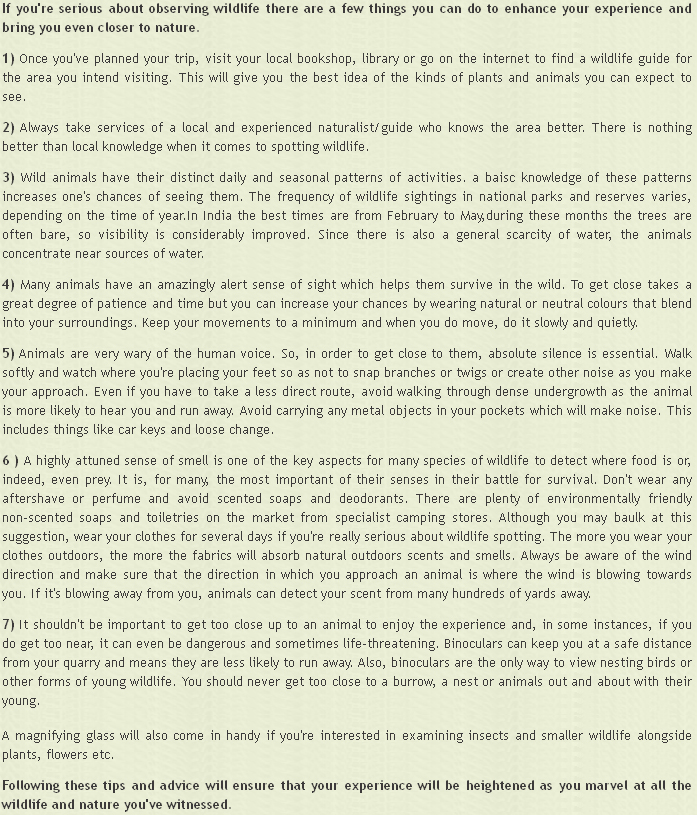
Animal Spotting Tips
Tiger Photography (Tour Highlight)
| City | Tour Highlight |
| Delhi | Jama Masjid, Red Fort, Raj Ghat, India Gate, President House, Birla Mandir, Humayun’s Tomb, Safdarjang’s Tomb, Qutub Minar. |
| Jaipur | City Palace, Johri Bazaar, Hawa Mahal, Jal Mahal, Amer Fort. |
| Ranthambore | Jeep / Canter Safari in the National Park. |
| Bharatpur | Rickshaw Ride, Nature Walk in the Park for bird watching, Lord Shiva Temple. |
| Agra | Fatehpur Sikri, Taj Mahal, Red Fort. |
| Bandhavgarh | Jeep / Elephant Safari in the National Park. |
Get a Call Back from us
Please provide us your contact number and convenient time, our expert will call back to you.


