Jim Corbett National Park, Uttarakhand
Area: Core Area: 520.82 sq km and Buffer Area: 797.72 sq km
Year of Establishment: 1936
Best time to Visit: October to June
Please provide us your contact number and convenient time, our expert will call back to you.
India's first National Park, the tigers' land, and the paradise of nature lovers, Jim Corbett National Park is the pride of Nainital District of Uttarakhand. Glorified by the name of the legendary hunter-turned conservationist Jim Corbett, the park is one of the best wildlife sighting destinations in the country. A gem on the necklace of the Himalaya, the park is the habitat of exotic species of animals including a good population of big cats.
The park is named after the renowned hunter-turned-conservationist Edward James Jim Corbett, who spent a major part of his life in this park vicinity and fought hard to turn this vulnerable forest into a protected area for the free movement of animals. Due to the constant support of the government and dedicated care of the park authority, the number of tigers is increasing day by day in the process encouraging global tourists to head to this promising tiger sighting spot of India.
This is the park where Save Tiger Project was launched for the first time. It was an initiative taken by the Government of India for the protection of the tiger population.
Geographical Information
This reserve forest area shares the ecological characteristics of Sub-Himalayan belt and ranks as a perfect eco-tourism destination. The park is Located between 29°25' to 29°39'N latitude and 78°44' to 79°07'E longitude. The average altitude of the region ranges between 360 m (1,181 ft) and 1,040 m (3,412 ft).
Flora in Corbett National Park
Corbett is covered with dense vegetation and around 488 species of plants are recorded in this park. Some of the various plant species found inside the park are Bel, Chbilla, Bakli, Dhak, Pula, Semal, Bamboo, Khair, Khingan, Sal, Sissoo, Ber, Kharpat, Kuthber, Rohini. The vegetation in Sal forests is dense and lowest in the Anogeissus-Acacia catechu forests.
Project Tiger in Corbett
To ensure the safety of India's national animal Royal Bengal Tiger in their natural habitat, and to save them from extinction the Government of India launched the Project Tiger program in 1st April, 1973. The project was first launched in the Dhikala Zone of Corbett with the motto of extending the 588 sq km area of the park. The project was initiated taking monetary help of World Wildlife Fund. Under the prevalence of this project the government has formed a Tiger Protection Force to trap the poachers. Moreover, to minimize human-tiger conflicts initiative is taken for funded relocation of villagers.
Different Entry Zones of Corbett
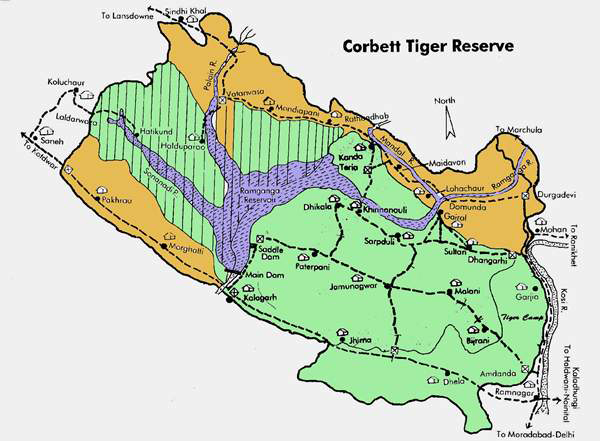
It is difficult for the wildlife lovers to visit the entire park at a stretch. Keeping in mind the vast area of the park, it is divided into different zones for systematic and regulated wildlife sighting. The reserve is mainly divided into four different zones namely:
- Bijrani Zone
- Dhikala Zone
- Jhirna Zone
- Domunda Zone
General Information
Altitude: 385 m - 1100 m above mean sea level
Annual rainfall: 1400-2800 mm
Temperature range: 4°C in winter to 42°C during summer
When to Visit
Every year from November to mid June, Corbett National Park remains open to the public. Once the monsoon season bids good bye to the Nainital region the repair works of the road gathers pace. It is because most of the roads connecting Corbett to other parts of the state get washed away. During monsoon season, other than the Jhirna zone, the other three zones remain closed.
 Restaurant
 Internet Service
 Tea/Coffe Machine
 Business Centre
 Swimming pool
 Travel Desk
 Doctor on Call
 Baby Sitting
 Health club
  Bar
Bar Safe Deposit
 Amphitheatre
 Library
 Std/Isd
  Money Exchange







Corbett National Park Wildlife Tour Packages
Corbett National Park Tour Packages-1
| Tour Name | India Wildlife Special Tour |
| Duration | 13 nights & 14 days |
| Destinations Covered | Delhi - Sariska Tiger Reserve - Ranthambore National Park - Jaipur - Bharatpur Bird Sanctuary - Agra - Corbett National Park - Dhikala - Delhi |
Corbett National Park Tour Packages-2
| Tour Name | Wildlife of Corbett |
| Duration | 03 nights & 04 days |
| Destinations Covered | Delhi - Corbett National Park - Delhi |
Corbett National Park Tour Packages-3
| Tour Name | India Tiger Tour |
| Duration | 13 nights & 14 days |
| Destinations Covered | Delhi - Agra - Umaria - Bandhavgarh National Park - Kanha National Park - Nagpur - Delhi - Corbett National Park - Delhi |
Corbett National Park Tour Packages-4
| Tour Name | Wildlife and Rajasthan Special India |
| Duration | 27 Nights & 28 Days |
| Destinations Covered | Mumbai - Nagpur - Kanha - Bandhavgarh National Park - Agra - Bharatpur - Sawai Madhopur - Ranthambore National Park - Mandawa - Bikaner - Jaisalmer - Jodhpur - Udaipur - Pushkar - Jaipur - Delhi - Corbett National Park - Delhi |
Corbett National Park Tour Packages-5
| Tour Name | Corbett Weekend Tour |
| Duration | 03 nights & 04 days |
| Destinations Covered | Delhi - Corbett National Park- Delhi |
Corbett National Park Tour Packages-6
| Tour Name | Uttarakhand Tour Packages |
| Duration | 12 nights & 13 days |
| Destinations Covered | Delhi - Dehradun- Rishikesh - Raja Ji National Park - Kaudilya - Haridwar - Nainital- Ranikhet - Corbett National Park - Delhi |
Corbett National Park Tour Packages-7
| Tour Name | Tiger and himalaya |
| Duration | 10 nights & 11 days |
| Destinations Covered | Delhi- Corbett National Park- Ranikhet- Kausani- Almora -Nainital -Delhi |
Corbett National Park Tour Packages-8
| Tour Name | Uttarakhand Bird Watching Tour: |
| Duration | 15 nights & 16 days |
| Destinations Covered | Delhi - Corbett National Park - Pangot - Sat Tal - Mukteshwar - Binsar - Rajaji National Park - Delhi |
The Wildlife in Corbett National Park
The diversity of wildlife found in Corbett National Park is interesting and chances are high that one may get to witness some of these animals from a close distance. The commonly found animals in this park can be classified under following category:
Mammals: The Himalayan Black Bear, Sloth Bear, Dhole, Yellow Throated Martem, Jackal, Himalayan Palm Civet, Common Otter, Indian Grey Mongoose, Porcupine, Clack-taped Hare are the commonly found animals in Corbett. Sometimes huge numbers of elephants are witnessed inside the park. Total four species of deer are found inside Corbett which includes the names of Chital, the well-known Spotted Deer, Para, Kakka, and the Barking Deer. The Goat Antelopes are represented by the Ghoral.
Birds: Around 580 species of birds are found in Corbett. Most of the aquatic birds are migratory and arrive here in winters. Some of the significant species of birds that are found here are the Bar-headed Goose, Greylag, Duck, Snipe, Grepe, Gull, wagtail and Sandpiper. The birds which are endemic to the park are Darters, Egrets, Cormorants, the black-necked Stork, Herons, and the spur winged Lapwings.
Reptiles in Jim Corbett: The reptiles that are residents of Corbett are the Gharial, long - nosed Crocodile, and different species of Turtles and Tortoises. The Indian Python, Cobra, Viper, King Cobra and Krait inhabit the Corbett National Park.
Fishes: River Ramganga flows inside the park and houses different species of fishes that satiate the thirst of anglers and fishing lovers. Among the most exotic species of fishes found in this river, Mahaseer, kalimuchi, kalabasu, chilwa and goonch are most popular.
Corbett National Park Travel Information
The park is connected with other parts of the world by all modes of transport.
By Air: Phoolbagh, Pantnagar is the nearest domestic airport to Corbett. It is 50 km away from the park. However, IGI in Delhi is the nearest international airport.
By Rail: Ramnagar is the nearest rail head to Corbett National Park. Direct train is available from Delhi. The rail station is located 12 km away from the park.
By Road: Ramnagar is well connected by road to the major cities like Delhi, Bareilly, Moradabad, and Naintial. State transport buses ply regularly from Delhi, Moradabad, and Haldwani to Ramnagar.
Corbett National Park Map