Elephant Safari in India
- Elephant Safari in Corbett
- Elephant Safari in Bandhavgarh
- Elephant Safari in Kanha
- Elephant Safari in Pench
- Elephant Safari in Panna
- Elephant Safari in Kaziranga
- Elephant Safari in Manas
- Elephant Safari in Jaldapara
- Elephant Safari in Nagarhole
- Elephant Safari in Bandipur
- Elephant Safari in Dandeli
Jeep Safari in India
Jim Corbett Elephant Safari Tour
Delhi - Corbett National Park - Delhi
Day - 01 : Delhi - Corbett National Park
Depart early from New Delhi to arrive for lunch at the wildlife resort. Take a nature walk accompanied by a naturalist, along the Kosi River. This area is a bird watcher's paradise. In the evening watch a slide show on the flora & fauna present in the Corbett area.
Day - 02 : Corbett National Park
Jeep Safari in Corbett National Park for tiger tracking. Drive along the Ramganga, to look for some fish-eating Gharial and Marsh Crocodiles. If you are lucky enough, you will possibly see the some species of Kingfishers, Pallas & Himalayan Greyheaded Fishing Eagles, Osprey, Crested Serpent Eagle and of course the Mammalia. Later on arrive at Dhikala, where the natural setting will take your breath away. Have lunch and rest for while, enjoying the panoramic view of the grassland area and its abundant wildlife. The elephant ride from Dhikala provides the opportunity get a close view of the Himalayan wildlife. Jeep ride back to the lodge for overnight stay.
Day - 03 : Corbett National Park
Early morning Jeep Safari in the Ghairal area and into the awesome wilderness of the Corbett national park. Arrive at the wildlife resort. Drive in a jeep to get to the start-off point of the Elephant safari. Enroute visit Kanda situated at an elevation of 1,020m, where Jim Corbett shot the Kanda Man-eater. After having a picnic lunch, start the Elephant Safari in the Himalayan foothills. Arrive, after enjoying the leisure ride, at the forest rest house, built in British bungalow style for overnight stay in the wilderness.
Day - 04 : Corbett National Park
Start a full day wildlife expedition on an Elephant back, stopping enroute at a picturesque spot for breakfast. Stop by again for rest at a forest rest house and letting the elephant also some break as well as bath in the stream. After rest, start the Elephant safari for the Sonanadi sanctuary, going along the Rocky Plain river, the forested areas and the scenery is spectacular over here. Arrive at the Halduparao Forest Rest House, built in 1892 it was broken down by the Wild Elephants and abandoned. The Sonanadi Sanctuary was included in the Corbett Tiger Reserve and this Forest Rest House was restored, a few years ago. After a hot water bucket wash, get together at a campfire. Overnight stay at the forest rest house.
Day - 05 : Corbett National Park
Wildlife enthusiasts can also choose option of either going for an elephant ride or Jeep Safari or go for a forest trail with an armed guard in the Sonanadi Sanctuary area, for wildlife viewing. After having breakfast, depart by Jeep with packed lunch via Sendhikhal / Saneh / Morghatti / Kalagarh / Jhirna / Dhela / Ramnagar, reaching the resort by late evening.
Day - 06 : Corbett National Park - Delhi - Onward Destination
After breakfast depart for the onward journey from the Corbett national park.
Tour and Services Ends.
Animal Spotting Tips
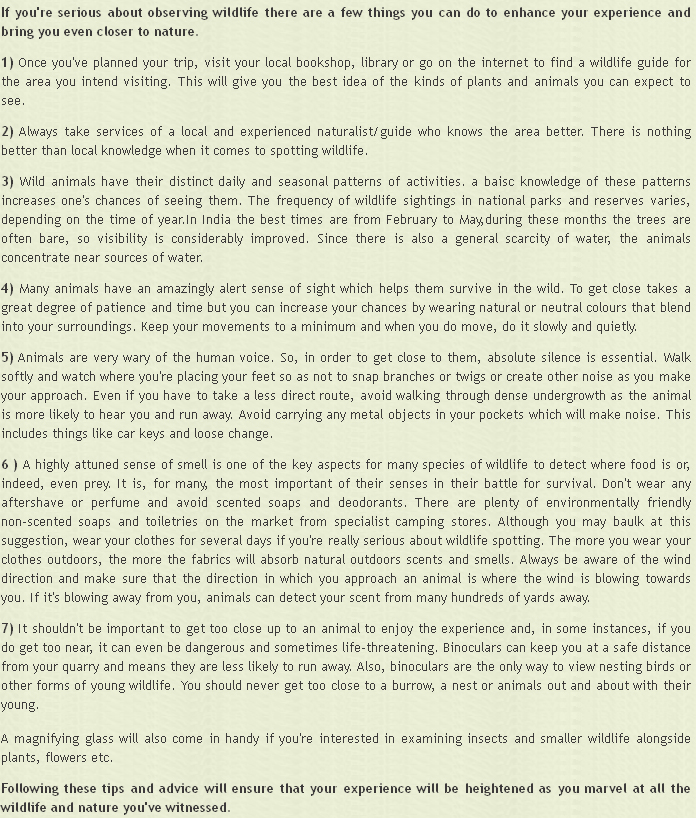
If you're serious about observing wildlife there are a few things you can do to enhance your experience and bring you even closer to nature.
1) Once you've planned your trip, visit your local bookshop, library or go on the internet to find a wildlife guide for the area you intend visiting. This will give you the best idea of the kinds of plants and animals you can expect to see.
2) Always take services of a local and experienced naturalist/guide who knows the area better. There is nothing better than local knowledge when it comes to spotting wildlife.
3) Wild animals have their distinct daily and seasonal patterns of activities. a baisc knowledge of these patterns increases one's chances of seeing them. The frequency of wildlife sightings in national parks and reserves varies, depending on the time of year.In India the best times are from February to May,during these months the trees are often bare, so visibility is considerably improved. Since there is also a general scarcity of water, the animals concentrate near sources of water.
4) Many animals have an amazingly alert sense of sight which helps them survive in the wild. To get close takes a great degree of patience and time but you can increase your chances by wearing natural or neutral colours that blend into your surroundings. Keep your movements to a minimum and when you do move, do it slowly and quietly.
5) Animals are very wary of the human voice. So, in order to get close to them, absolute silence is essential. Walk softly and watch where you're placing your feet so as not to snap branches or twigs or create other noise as you make your approach. Even if you have to take a less direct route, avoid walking through dense undergrowth as the animal is more likely to hear you and run away. Avoid carrying any metal objects in your pockets which will make noise. This includes things like car keys and loose change.
6 ) A highly attuned sense of smell is one of the key aspects for many species of wildlife to detect where food is or, indeed, even prey. It is, for many, the most important of their senses in their battle for survival. Don't wear any aftershave or perfume and avoid scented soaps and deodorants. There are plenty of environmentally friendly non-scented soaps and toiletries on the market from specialist camping stores. Although you may baulk at this suggestion, wear your clothes for several days if you're really serious about wildlife spotting. The more you wear your clothes outdoors, the more the fabrics will absorb natural outdoors scents and smells. Always be aware of the wind direction and make sure that the direction in which you approach an animal is where the wind is blowing towards you. If it's blowing away from you, animals can detect your scent from many hundreds of yards away.
7) It shouldn't be important to get too close up to an animal to enjoy the experience and, in some instances, if you do get too near, it can even be dangerous and sometimes life-threatening. Binoculars can keep you at a safe distance from your quarry and means they are less likely to run away. Also, binoculars are the only way to view nesting birds or other forms of young wildlife. You should never get too close to a burrow, a nest or animals out and about with their young.
A magnifying glass will also come in handy if you're interested in examining insects and smaller wildlife alongside plants, flowers etc.
Following these tips and advice will ensure that your experience will be heightened as you marvel at all the wildlife and nature you've witnessed.
Please provide us your contact number and convenient time, our expert will call back to you.


