


Lions of Gir Tour
Delhi - Ahmedabad - Bhavnagar - Gir National Park - Zainabad - Ahmedabad - Delhi or Mumbai
The lions that figure in the stories off the Bible and ranged through Persia to North of India are now confined to a tiny pocket in the Saurashtrian Peninsula in Western India.
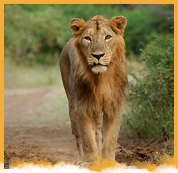 Called the Asiatic Lion, little more than two hundred of these magnificent animals survive in the 300 sq. km. Of Gir National Park. Their numbers have recouped from about 20 in 1913 to present level after the Nawabs of Junagarh initiated conservation measures.
Gir also has a large population of Leopards that are more easily seen here than elsewhere. Also to be seen are Samber, Chital, Chinkara, Chousingha, Nilgai and wild boar.
North of Gir is the little Rann of Kutch where the last stand of wild asses survive numbering over 1000. They are found in herds of 30 or so and are capable of with standing great dehydration. This is also a guest place for Cranes, flamingoes and lots of other birds found in large numbers.
DAY 01: Delhi / Ahmedabad / Bhavnagar (203 km)
Transfer to the airport to board the flight for Ahmedabad. On arrival at Ahmedabad airport you will be meet by our representative and transfer to Bhavanagar. On arrival check in at the hotel. Overnight at hotel.
DAY 02: Bhavnagar / Sasan Gir ( 240 km) 4 ½ hrs
Morning after breakfast drive to Gir National Park. On arrival check in at the wildlife resort/camp. In the afternoon lion safari to the national park. Overnight at resort / camp.
DAY 03: Gir National Park:
Morning and afternoon safari to the national aprk for wildlife viewing. Overnight at resort / camp.
Gir National Park: Established on 18th September, 1965, as a Forest Reserve, primarily to conserve the Asiatic lion-classified as one of the World's most threatened species. Now Gir National Park is the only remaining place in the world, where one is likely to see the Asiatic Lion. The sanctuary covers a total area of 1,412 sq. km of which 258 sq.km at the core forms the National park. Permits are required to enter this part of the sanctuary.
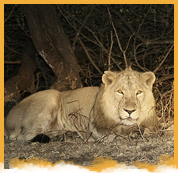 The Asiatic lion once had a wide range in natural territory running from NW India through Persia to Arabia. But unfortunately hunted as a coveted trophy item during the British Raj era, it is now only found in the Gir forest of Gujarat. The famine of 1899 so decimated the Asiatic lion population that Lord Curzon cancelled his shoot at Gir, where he was staying as the guest of Nawab Junagadh. Curzon persuaded the Nawab to protect the remaining lions. In 1965, the India Government declared this place as a National park. The lion population which had sunk to an alarming two dozen in the early 20th century has slowly climbed over the years since, and now numbers about 300.
DAY 04: Gir National Park:
Morning and afternoon Jungle excursion in the Park. Overnight at resort / camp.
DAY 05: Gir / Zainabad (225 km) 5 hrs
Early morning birding around fringes of Sasan Gir. After breakfast, drive to Zainabad. En route visit the fringe of the Little Rann of Kutch, we will stop at some water holes to check birds. On arrival check in at the camp/resort. Overnight at Camp Zainabad
DAY 06: Zainabad
Morning jeep safari to the Rann of kutch for wild life and birding watching. Birds on the ground, aquatic species ,Wild Ass, other mammals and reptiles will be observed. Overnight at Camp Zainabad.
DAY 07: Zainabad / Ahmedabad (110 km) 2 ½ hrs. / Delhi
Morning after breakfast drive to Ahmedabad, on arrival transfer to the airport to board the flight for Delhi.
Tour and Services Ends.

Animal Spotting Tips

Lions of Gir Tour(Tour Highlight)
| City | Tour Highlight |
| Delhi | Safari in the National Park. |
| Zainabad | Jeep Safari in the Rann of Kutch. |
Get a Call Back from us
Please provide us your contact number and convenient time, our expert will call back to you.


